How will I feel?

Back1

After a massage with Monica Bemus most people feel very relaxed. Some experience freedom from long-term aches and pains developed from tension or repetitive activity. After an initial period of feeling slowed down, people often experience increased energy, heightened awareness, and greater productivity, which can last for days. Since toxins are released from your soft tissues during a massage, it is recommended you drink plenty of water afterward.

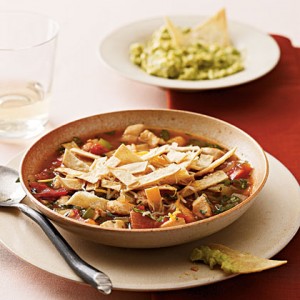
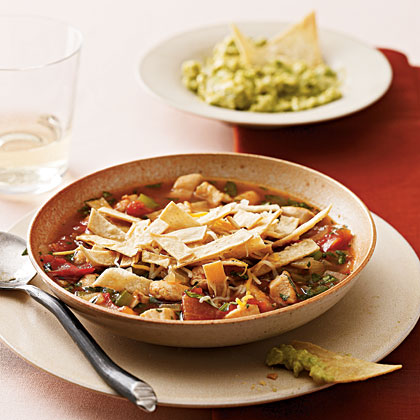
Mexican Tortilla Soup

tortilla soup

Photo Yunhee Kim; Styling: Molly Fitzsimons/Big Leo Productions

Ingredients
2 teaspoons olive oil, divided
12 ounces skinless, boneless chicken breast, trimmed and diced
1 cup prechopped onion (find at the salad bar)
1 cup prechopped green bell pepper (find at the salad bar)
2 garlic cloves, minced (1 teaspoon)
3/4 teaspoon ground cumin
3/4 teaspoon chili powder
2 (14-ounce) cans fat-free, less-sodium chicken broth
1 (14.5-ounce) can diced tomatoes, undrained
1/3 cup chopped fresh cilantro
1/2 cup coarsely crushed baked tortilla chips (such as Tostitos)
1/2 cup preshredded reduced-fat Mexican blend cheese
6 lime wedges (about 1 1/2 limes)

Directions:
1. Heat 1 teaspoon oil in a nonstick Dutch oven over medium-high heat. Add the chicken, and cook, stirring often, 3-4 minutes or until browned. Remove to plate, and cover.

2. In the same pan, heat remaining 1 teaspoon oil on medium-high. Add onion, bell pepper, and garlic. Cook, stirring often, 5 minutes or until softened. Stir in cumin, chili powder, broth, and tomatoes. Bring to a boil. Reduce heat, and simmer 5 minutes.

3. Return the chicken and juices to the pan and simmer 3 minutes or until heated through. Stir in cilantro.

4. Ladle soup into serving bowls; top with crushed tortilla chips and cheese. Serve hot, with a lime wedge on the side.

Prep Time: 10 minutes
Cook Time: 16 minutes
Yield: Makes 6 servings (serving size: 1 cup)


Dehydration

water-glass

Dehydration occurs when your body loses too much fluid. This can happen when you stop drinking water or lose large amounts of fluid through diarrhea, vomiting, sweating, or exercise. Not drinking enough fluids can cause muscle cramps. You may feel faint. Usually your body can reabsorb fluid from your blood and other body tissues. But by the time you become severely dehydrated, you no longer have enough fluid in your body to get blood to your organs, and you may go into shock, which is a life-threatening condition.

Dehydration can occur in anyone of any age, but it is most dangerous for babies, small children, and older adults.

Babies and small children have an increased chance of becoming dehydrated because:
• A greater portion of their bodies is made of water.
• Children have a high metabolic rate, so their bodies use more water.
• A child’s kidneys do not conserve water as well as an adult’s kidneys .
• A child’s natural defense system that helps fight infection (immune system) is not fully developed, which increases the chance of getting an illness that causes vomiting and diarrhea.
• Children often will not drink or eat when they are not feeling well.
• They depend on their caregivers to provide them with food and fluids.

Dehydration in older adults

Older adults have an increased chance of becoming dehydrated because they may:
• Not drink because they do not feel as thirsty as younger people.
• Have kidneys that do not work well.
• Choose not to drink because of the inability to control their bladders (incontinence).
Have physical problems or a disease which makes it:
• Hard to drink or hold a glass.
• Painful to get up from a chair.
• Painful or exhausting to go to the bathroom.
• Hard to talk or communicate to someone about their symptoms.
• Take medicines that increase urine output.
• Not have enough money to adequately feed themselves.

Watch babies, small children, and older adults closely for the early symptoms of dehydration anytime they have illnesses that cause high fever, vomiting, or diarrhea. These are the early symptoms of dehydration:
• The mouth and eyes may be drier than usual.
• The urine may be darker than usual.
• The person may feel cranky, tired, or dizzy.

Rotator Cuff Injury & Tears

Rotator cuff

It’s one of the darkest fears of pitchers, tennis players, and many other athletes: a rotator cuff tear. If it is severe, a rotator cuff tear can end a player’s career. So what is it, exactly?

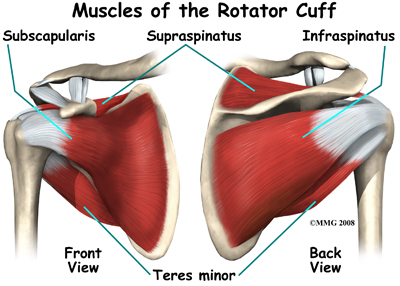
The rotator cuff is a group of four tendons and muscles that converge around the shoulder joint at the top of the humerus, the upper arm bone above the elbow. Together, they form a ”cuff” that both holds your arm in place and allows it to move in different directions. While your shoulder is one of your most mobile joints, it’s also somewhat weak. Too much stress — or too many fastballs — can cause partial tears and swelling in the tendons of the rotator cuff. Abrupt stress may even cause one of the tendons to pull away from the bone or tear in the middle of the tendon. Rotator cuff tears are sometimes incorrectly called ”rotary cuff tears.”

Athletes prone to getting rotator cuff tears include:
•Baseball players, especially pitchers
•Swimmers
•Tennis players
•Football players

You can get a rotator cuff tear by:

•Falling on your shoulder
•Using an arm to break a fall
•Lifting heavy weights

What Are the Symptoms of a Rotator Cuff Tear?

The symptoms of a rotator cuff tear include:
• Pain in the shoulder and arm, which varies depending on how serious the tear is
• Weakness and tenderness in the shoulder
•Difficulty moving the shoulder, especially when trying to lift your arm above your head
•Snapping or crackling sounds when moving the shoulder
•Inability to sleep on the shoulder

Most rotator cuff tears develop gradually. But they also can happen suddenly — you might feel a pop, intense pain, and weakness in the arm.

To diagnose a rotator cuff tear, your doctor might want to order the following tests:
•X-ray of the shoulder with some special views
• MRI (Magnetic Resonance Imaging)
• Arthrogram, a special type of X-ray or MRI done after a dye is injected into joint; this will allow your doctor to see more detail.
• Arthroscopy, a minimally invasive surgical procedure in which a tiny camera is inserted into the shoulder joint to get a look at the rotator cuff Arthroscopy is usually not done unless it is likely that you will need a surgical repair based on the other non-surgical tests.

These tests will allow your doctor to rule out other conditions and confirm that you have a rotator cuff tear. He or she may refer you to an orthopedic surgeon for treatment.

What’s the Treatment for a Rotator Cuff Tear?

As bad as these injuries can be, the good news is that many rotator cuff tears heal on their own. You just need to give them a little time. You also should:
• Rest the joint as much as possible. Avoid any movement or activity that hurts. You may need a sling.
• Ice your shoulder two to three times a day to reduce pain and swelling.
•Perform range-of-motion exercises
•Consider physical therapy to strengthen the joint.

More serious rotator cuff tears require surgery. One procedure is shoulder arthroscopy, usually an outpatient procedure. During an arthroscopy, the patient is put to sleep with general anesthesia. A small camera is inserted into the shoulder to see and repair the rotator cuff tear. If the tear is very large or involves more than one tendon, a small incision may be needed. Following arthroscopy, the arm will likely be in a sling for two to three weeks and physical therapy will be prescribed.


Slimmed Down Green Been Casserole

Ingredients
3 to 4 medium shallots, in their skins
Kosher salt, plus 1 1/2 teaspoons
1 pound fresh green beans, stemmed, and halved crosswise
1 tablespoon extra-virgin olive oil
8 ounces cremini mushrooms, sliced (about 4 cups)
2 tablespoons unsalted butter
3 tablespoons all-purpose flour
1 1/2 cups mushroom, vegetable, or chicken broth (see Cook’s Note)
3 teaspoons fresh thyme leaves
Freshly ground black pepper
Vegetable cooking spray
1 cup fresh bread crumbs

Directions
Preheat the oven to 400 degrees F. Put the shallots (in their skins) on a small baking dish, roast until soft, about 30 minutes. When cool enough to handle, skin and coarsely chop the shallots. Set aside.

Bring a medium-large saucepan of water to a boil over high heat. Add kosher salt, to taste. Add the green beans, and cook, uncovered, until crisp-tender and bright green, about 3 minutes. Drain the beans in a colander and rinse with cold water. Transfer the beans to a large bowl.

In the same saucepan, heat the oil over medium heat. Add the mushrooms, season with 1 teaspoon salt, cook, stirring occasionally, until browned, about 7 minutes. Add the mushrooms to the beans.

Melt the butter in a small saucepan over medium heat. Add the flour and cook, stirring with a wooden spoon, until golden, about 2 minutes. Slowly whisk in the broth, increase the heat to high, and bring to a boil. Add the shallots, 1 teaspoon of the thyme, and remaining 1/2 teaspoon of salt. Reduce the heat to maintain a simmer and cook until thickened, stirring occasionally, about 5 minutes. Pour the sauce over the vegetables and stir to combine evenly.

Spray a 2-quart baking dish with vegetable cooking spray. Transfer the vegetable mixture to the pan. Add the remaining 2 teaspoons of thyme to bread crumbs and scatter over the vegetables. Bake uncovered until the sauce bubbles and the crumbs brown, about 20 minutes.

Cook’s Note: There has been an explosion of prepared broths on the market. We particularly like the mushroom broth in the aseptic packaging. However, for this recipe, make sure you don’t use an Asian-style mushroom broth. If you can’t find mushroom, a vegetable or chicken broth is a suitable substitute.

Tips: – When sauteing mushrooms, salt them right away–they will release moisture and you can use less oil – 1 cup fresh bread crumbs has less calories than 1 cup dried – Roasting whole shallots is an excellent way to cook them using absolutely no fat.

Dirty Dozen

Whether you are on a budget and need to prioritize your organic purchases, or you would simply like to know which type of produce has the highest pesticide residues—and which do not—the following guide from the Environmental Working Group will help.

12 Most Contaminated
Peaches
Apples
Sweet Bell Peppers
Celery
Nectarines
Strawberries
Cherries
Pears
Grapes (Imported)
Spinach
Lettuce
Potatoes

12 Least Contaminated
Onions
Avocado
Sweet Corn (Frozen)
Pineapples
Mango
Asparagus
Sweet Peas (Frozen)
Kiwi Fruit
Bananas
Cabbage
Broccoli
Papaya